Funding for Agri-food Data Canada is provided in part by the Canada First Research Excellence Fund



Value of Data
Uh-oh here she goes again! I’ve been pondering the direction I wanted to take with this post – do I dig more into the data opportunities that may exist in the OAC Annual reports? or twist my Rubik’s cube to look at a different facet of this ongoing conversation. Let’s look at another facet.
You may recall that we created a tagline for Agri-food Data Canada (ADC) a few years ago:
Making agri-food data FAIR!
Remember Findable Accessible Interoperable Reusable. If you’ve been following this blog, you know we have gone into detail on FAIR and the tools that we have created to make the data FAIR. Now the question- which I have posed in the past also – do we need to qualify WHAT data we make FAIR? Does someone need to decide which data has more “value” and should be FAIR? Oh you know that question will not end well! So, let’s be objective and take that tagline at face value – agri-food data – whether it is created today or 150+ years ago. I know this may seem a little counter to what I said a few weeks ago – but I do feel that we need to think about the goal! Why would we want to make that 150+ data FAIR? What am I going to use that historical data for? If we can find it, dig it out, and document the older data – we also need to think about the resources that are needed to create that FAIR data resource AND do they outweigh how and if the data will be Reused? Back to that circular conversation again 🙂
So why am I bringing this up yet again? Because I was reminded this week – that there are INDEED projects out there – Canadian projects – that are indeed using older and historic datafiles. For instance check out: The GeoREACH Lab at UPEI – a FABULOUS use case for using historical data.
So…. back to my original question – is there VALUE in historical ag data? Should we spend the resources to uncover that hidden data trove of OAC research?

Wow! Isn’t it amazing how our world can change in an instant? Remember not that long ago when AI was an up and coming “thing” but not yet a mainstream facet of our research lives? Now it seems everything is about AI or has some AI component to it. I’m not saying that it’s a bad thing nor am I loving it – I’m just stating the facts! It does worry me a bit though – but then again I’m an old fogey who is kinda set in her ways 😀
Research funding calls now seem to be centred around AI – which is great but again there is a challenge to this that I think folks are missing. If you are building tools to enable researchers – how will an LLM fit in? How do we hit pause or rather encourage the research to slow down just a little until we can convince our researchers that we need those basic building blocks before we go and build the next CN tower. Alright Michelle – what are you really trying to say?
AI and LLM can help us build and expand our data ecosystems – but if we don’t have the basics – aka documentation – how can build an effective tool and LLM? Remember the old adage used in statistics? Garbage in – garbage out? If we cannot create proper documentation for our datasets – then what will the AI models use?
AI is a great tool – but I think we need to remember exactly that – it is a tool! We can use it to enhance our current data ecosystems – but let’s not rely on it. We need to teach our up and coming students those basic building blocks – what is data, what is an attribute, what is a data type, etc…. before we unleash the AI tools that promise to make our lives easier.
Would love to hear your thoughts on this!
That is the question to ask – when it comes to historical research data.
So – yes I found some of the original research data that was collected by OAC researchers back in 1877 – BUT… do we spend the time and resources into pulling it out of the PDFs and making it accessible to the world? I know I’ve asked this question in a different way in previous posts – but it’s a question that keeps coming up.
There are definitely aspects of this question that need to be objectively reviewed:
- WHY? undertake this venture? For curiosity or because it is valuable to you as a researcher?
- HOW far back do we go? 10 yrs? 50 yrs? 150 yrs?
- WHERE will you keep this data? Hmm… that’s a big question today!
- WHO? will steward this data?
As a data geek – I want to pull this out and steward it – but I have to be practical about it as well. How much have research technologies changed over this time period? How valid is this data today? Let’s think about this in a different way. Textbooks – When we teach we update our textbooks on a regular basis since there is new materials to teach and new ways to view and teach the materials. I have Statistics textbooks going way back – 1950s – but I don’t use these to teach – I use the new updated 2025 texts. I may read the older texts to get a perspective on why or how things have changed – but I will use the newer texts as resources for my students.
Let’s go back to data. I have this cool data on weights and feed intakes of animals in the 1870s but our animals have changed over the past 150+ years. Is the historical data really of use in today’s active research projects? Probably not – unless you are a historian? See – how I can always find a way or reason to keep this data? But really, time and available resources come into play – do we have the time, money, and resources to create and preserve this data – that may or may not be of use?
Oish! I can talk circles around this! I believe that everyone will come to a point where they will need to make these types of decisions – but for today’s research data – let’s document it, and deposit into a repository – the data is relevant! Not like my 150+yr old data 🙂
Ah yes I’m on a roll with the historical data. Many of you have heard me ask “Where is the data?” If we have been conducting research or experiments for over 150 years here in Ontario – what do we have to show for it? As Data stewards – what happened? Where has that data gone? Yes I’ve talked about this in a variety of posts – the first one back in 2023:
As I prepare a few presentations for later this year, I’ve been asking myself this question: “If I don’t know the data ever existed – did it exist?” Similar to the saying: “If a tree falls in the forest and no one is around to hear it, does it make a sound?” I think we all know the “true” answer to that age old question – of course it makes a sound. To me – of course there was data to match experiments conducted 150+ years ago – it is just lost?
Can you sense that I found something 🙂 I’ve been reading the OAC Reviews and stumbled across a mention of the Annual Reports of the Ontario School of Agriculture and Experimental Farm. Yup!!! I found the very first report written by Wm. Johnston to the Commissioner of Agriculture on November 16, 1874 talking about the installation of the school – which is now known the Ontario Agricultural College. What a find!!! So – apart from the fascination of our history, including exams, list of students, finances, cropping reports, livestock inventories, etc… it was made clear from the first day that there would indeed be experiments on the farm:
“… in the first place, teach to the succeeding, if not the present generation, the most improved methods of cultivation—in one word, “ train young men in the science and art of improved husbandry ; ” and in the second, it must conduct experiments and publish the results.” The report talks about how this should happen – by having a “model farm” with the added capacity of conducting experiments. Now as you read through the reports, it is very clear that the authors are aware that this will take time – and they proposed it would take 5 years to have such a facility.
What I want to concentrate on is the Experiment section of these reports. They actually start in Volume 2 – that means there was an experiment, actually 2 livestock feeding trials were conducted in the winter and summer of 1876, and a plot experiment during the growing period of 1876. The data you ask?? Available in the reports!!! Here’s an example:
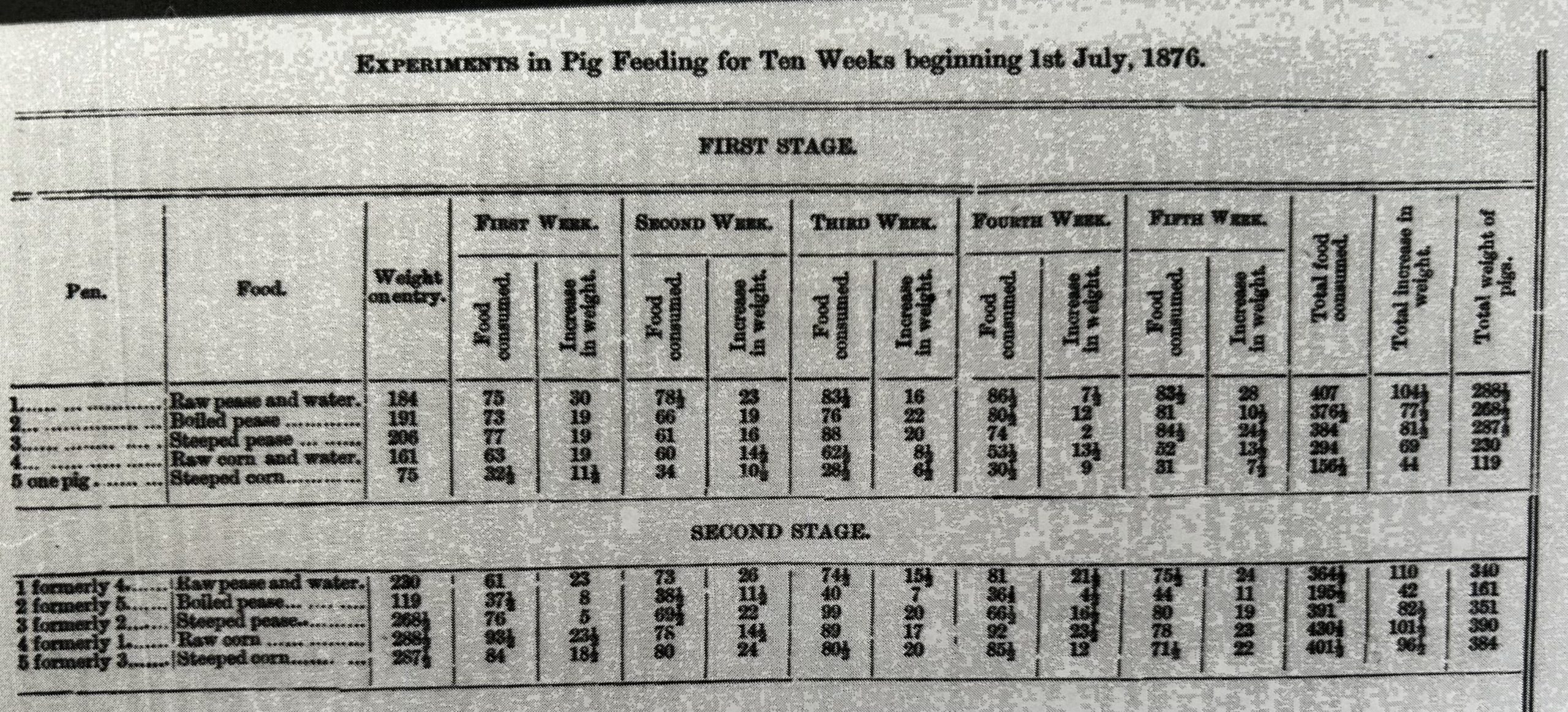
Source: Second Annual Report of the Ontario School of Agriculture and Experimental Farm. For the year ending 31st October 1876. Printed by the Order of the Legislative Assembly, Toronto: Printed by Hunter, Rose & Co., 25 Wellington Street West, 1875.
Now – apart from finding some of the OAC Historical data, what I really found interesting was the whole approach to research! I’ll leave you with one longer quote here and follow-up next time with some more thoughts and questions.
‘But, experiments are wanted now. There are A.B.C. duties owing the country and students in this response that must not be delayed – an initiatory work, having in view the testing of elementary principles, that should guide all sound, scientific, and practical farming in animal and plant life, with special reference to different modes of feeding, manuring and cultivation, or , as the Commissioners have put it, “to conduct experiments tending to the solution of questions of material interest to the agriculturists of the Province.”
While nothing definite has been laid before us, no suggestions, anything wanted by the farmers – something they would like to see done, it was thought desirable that simplicity should mark our first effort in this department, with growing experience as a guide, and practical utility our beacon – that is, will the experiment be useful to the general farmer, is it within the range of his daily work – can he lay his hands upon our results and follow them if desirable – will his land be enriched, his crops increased, and his stock give earlier and better returns? Another leading idea in feeding was, to use meantime only such materials as have been produced on the farm, or what are within the reach of any ordinary farmer.’
Wm. Johnston, President of the Ontario School of Agriculture and Experimental Farm
Wow!!! A few key phrases to highlight:
- conduct experiments and publish the results
- lay his hands upon our results and follow them if desirable
Let’s dig into these next time – maybe ask the question – why is Michelle pointing out these 2 phrases????
I’m sure by now you’ve heard of the AAFC news – seven research facilities closing with many job cuts. Research facilities with over a century of research, data, reports…. Oh you all know where I’m going with this!!! Yup! Where is all that data? Gone? Hidden? Maybe in some repository? I don’t know!
What I do know is that we, as an industry and as data researchers and archivists, need to seriously think about that data! Lacombe Research Centre – 119 years of research – many of these in the field of meat science! If anyone works in that area – you are well aware of the changes we’ve made over time in the quality of our meats – how we evaluate and grade – a lot of that research was developed at Lacombe! As a beef geneticist who worked in the meat science field, I am crying if that data is not saved or at least documented! Uh-oh I said that magic word “document”.
I’m trying to stay optimistic and hopeful – but when I attend industry related meetings and the primary question that arises is “What data?” followed by “Where is the data?” I get scared! The only reason I am familiar with the type of research and data that was collected at Lacombe is because of my research background. If I was to run a search today for pork grade data – ok – let’s try it for giggles.
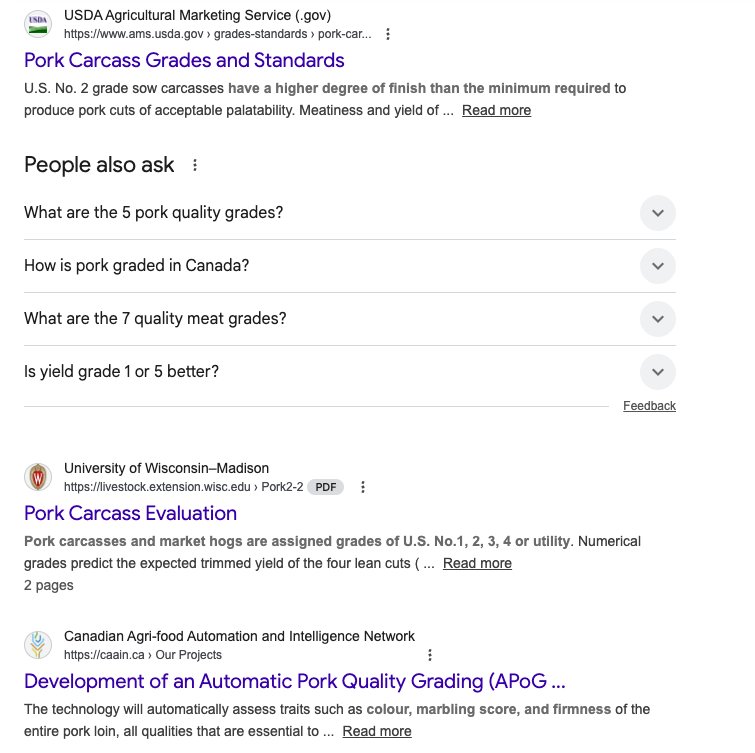
Hmmm… ok I should add Canada and see if that changes anything….
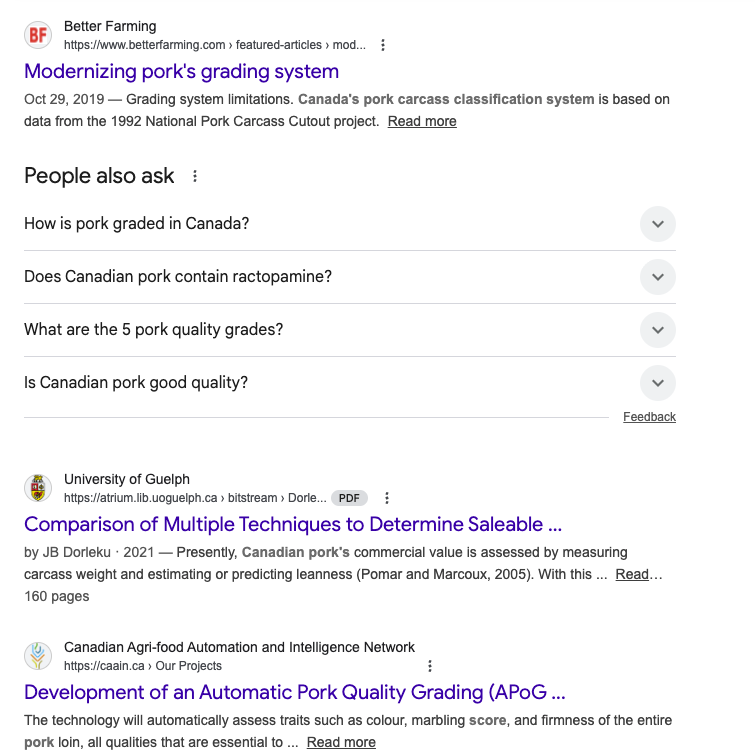
Yup! As I suspected nothing but reports – no data! So – that initial question of “What data?” followed by “Where is the data?” is not being answered!
Two points I want to make here:
- Data is NOT easy to find – nothing showing up for Lacombe information? If you didn’t know this data existed you wouldn’t know to ask about it. The classic “If you don’t know you don’t know!” So – if we don’t know it exists then it’s ok to let it go? Maybe I shouldn’t worry about the data that’s been collected for the past 119 years?
- This is the MAIN problem that we are trying to solve with both ADC and the CS-DCC! A catalogue of data sources to search across. A place to visit to determine IF the data exists – followed by where the data exists. BUT if we don’t know it exists or if it disappears then….
Let’s wake up and acknowledge that our data is VALUABLE and needs to be preserved!
Let’s hope I am wrong and the data collected at the seven AAFC facilities slated for closure will be preserved and FAIR!
Happy New Year and welcome back to a whole new year of blog posts by ADC!
A New Year is upon us and yet I’m still stuck questioning the value of data and how everyone else values data. I know I talked a bit about this last year in my What happened with the “old” data anyway? post and I know I have sprinkled this question in a few other posts, but I’m really struggling with the value or maybe the perceived value of TODAY’s data and not just the archived or “old” data. Are we just going to collect data as we have in the past, grab what we need from it, then let it sit on a shelf to be forgotten? We need to wake up and change the data culture, to recognize that in order to value data – we need to care for it!
Let’s see if I can explain my concerns and worries. In the agri-food industry, or really any industry, we talk about challenges at a very high level – is the industry sustainable, climate change outcomes, etc… We love to talk about the challenges, the impending changes, the effects any change may or may not have on a particular outcome, and really the list goes on….. If there is a data person involved in these conversations, you betcha that the answer ALWAYS falls back on the data to support whatever claim people are making.
BUT…..
My worry is the state of that data. I think it’s safe to say that many questions we ask – can indeed be answered with DATA. Isn’t that the basis of evidence-based decisions? But what happens if that data you are using to answer your question is NOT very well documented, is NOT stored and accessible for future use, is NOT managed or governed appropriately, or is NOT FAIR – do we have a problem?
If we recognize that data is important to help us make decisions then why are we NOT seeing resources aka funding set aside to ensure proper data management and governance? I know what you’re thinking – Michelle, you work in the research world – it’s really not your problem – so stop worrying! And that’s where I am really challenged – this problem goes beyond the research data world and I’m not getting the sense that anyone – beyond the data archivists and data managers are concerned about it! I’ve been actively participating in national data spaces meetings that cover data beyond the research field – such as industry/producer data, and in discussions such as the What is the State of Agri-Food Sustainability in Canada? CAPI Webinars – and the need for proper data management and governance beyond the research world is really becoming clear, and as an industry we are missing something crucial! We need to start seriously giving thought to supporting data management and governance at regional levels, at the associations, and at the producer level of the agri-food industry. In the research world, we can develop tools, such as the Semantic Engine and soon to be released Data Request Tracker – but we need more resources to get these out into the industry! OK let’s call that spade a spade – we need money and positions to make this a sustainable action. We need more efforts for training and discussions across the agri-food industry around the topics of data management and governance!
Oh my! Can you see I’m a tad passionate about this? If we can agree that DATA helps us make decisions – then let’s find a way to work together to better manage the data! Let’s get this data culture moving along and acknowledging the true value that data possesses.