


Research Activity Identifiers (RAiDs)
In Canada, national research data infrastructure is coordinated by the Digital Research Alliance of Canada (DRAC). The Alliance provides the digital tools and platforms that researchers depend on to manage data, perform advanced computing, and leverage research software. Supported by federal funding, DRAC works with partners across the country to expand access, improve security, and strengthen the digital research workforce. These efforts enable Canadian researchers in all disciplines to conduct more efficient, secure, and interoperable research.
As part of the ongoing modernization of Canada’s research infrastructure, DRAC is preparing to introduce a national Registration Agency for Research Activity Identifiers (RAiDs). RAiDs are a relatively new category of persistent identifiers designed to support the accurate identification, management, and linking of research activities—often conceptualized as research “projects”—throughout their full lifecycle.
Why RAiDs Matter
RAiDs provide a globally unique, persistent identifier for a research activity and connect that activity to:
-
People (researchers, collaborators)
-
Organizations (institutions, funders)
-
Outputs (publications, datasets, software)
-
Related resources (grants, ethics approvals, infrastructure)
This enables research projects to be tracked, referenced, and integrated across multiple systems. RAiDs are especially relevant in environments where interoperability is critical, such as national and international research data platforms.
For Canada, RAiDs are being positioned as a foundational component of the Canadian Research Data Platform, where they will facilitate information exchange between services, reduce duplication, and improve project-level transparency across institutions.
How RAiDs Are Minted
A key principle of the RAiD system is that researchers cannot independently mint RAiD identifiers. RAiDs must be generated through a recognized RAiD Service Provider. This approach ensures consistency, quality, and proper registration within the global RAiD infrastructure.
Two other identifiers have other minting processess:
-
ORCID allows individuals to mint their own researcher identifier at the ORCID website.
-
DOIs, however, must be issued by an authorized DOI service provider such as Dataverse, Zenodo, or Figshare.
RAiDs follow the DOI model rather than the ORCID model. Institutions, not individuals, carry the responsibility for minting and maintaining the associated metadata.
As DRAC moves toward becoming a national RAiD Registration Agency, Canadian researchers and institutions will gain a dedicated domestic pathway to obtain RAiDs that are recognized and resolvable globally.
The Global RAiD Registry
All RAiD identifiers and their metadata are maintained in a centralized global registry managed by the International RAiD Data Service, currently coordinated by the Australian Research Data Commons and partner organizations. This registry serves as the authoritative source for RAiD information and provides stable, persistent resolution of RAiD identifiers.
The registry stores:
-
The RAiD itself
-
Descriptive metadata about the research activity
-
Relationships to researchers, institutions, datasets, and grants
-
Activity lifecycle events (start, updates, completion)
-
Version histories and changes over time
Functionally, the RAiD registry operates in a manner similar to:
-
DataCite, which maintains DOI metadata
-
ORCID, which maintains researcher metadata
It is the central location where systems can query, resolve, and verify RAiD information.
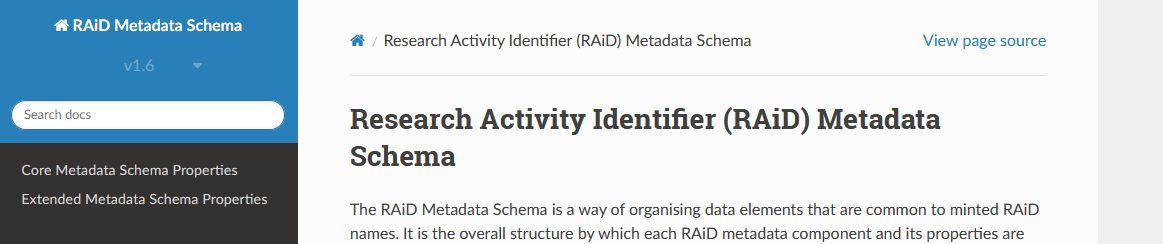
The RAiD metadata schema is published openly and can be reviewed at:
https://metadata.raid.org/en/v1.6/index.html
Can Anyone Use the RAiD Metadata Schema?
Any organization—or individual—can choose to document their research activities using the publicly available RAiD metadata model. However, without going through an authorized RAiD Service Provider, they cannot mint an official RAiD identifier, and the resulting record will not be registered in the global RAiD registry or participate in the broader RAiD ecosystem.
Official registration is what ensures global uniqueness, persistent resolution, and interoperability across research platforms.
Conclusion
RAiDs are emerging as a critical component of modern research infrastructure, offering a structured, persistent mechanism for identifying and connecting research activities with all related people, outputs, and systems. The Digital Research Alliance of Canada’s plan to establish a national RAiD Registration Agency represents a significant step toward improving the coordination, traceability, and interoperability of research in Canada.
As Canada’s research ecosystem continues to evolve, the adoption of standardized, globally recognized identifiers like RAiDs will support more transparent, connected, and efficient research workflows—benefiting researchers, institutions, and the broader scientific community.
Written by Carly Huitema